
Maslow’s Hierarchy of Needs
Applications for Education in a Post-Pandemic World
By Hillary Barber for Stellar Therapy
The COVID-19 pandemic wreaked havoc on an unsuspecting world. In a matter of weeks, norms were disrupted across all cultural, social, political, and economic sectors. In the United States, the fabric of society was torn apart, and all the norms we had come to depend upon were suddenly splintered. As the landscape of our lives became a veritable wasteland, chaos and confusion ensued. No branch of society was spared, especially our system of public education. As schools systems nationwide sought to find their way down new and untravelled highways, we began to realize that the education of the most vulnerable among us, our children, was
falling by the wayside.
Although an anomaly, the pandemic has continued, even today, to have unparalleled repercussions in the field of education. According to the National Assessment of Educational Progress (NAEP) a.k.a. the Nation’s Report Card, there has been a precipitous decline in fourth and eighth grade reading and math proficiency as demonstrated by scores obtained on the standardized NAEP assessments administered in the spring of 2023. Based on long-term statistical trend assessment of scores at selected percentile, subject, and grade levels, these results are indicative of a year-over-year decline in the general educational paradigm. Faced with these results, our teachers and other school professionals are encountering unique and unprecedented challenges in their efforts to reverse the detrimental effects of the pandemic in classrooms across the country.
In their attempts to counterbalance the adverse effects of the pandemic and to restore a semblance of academic normalcy, educators have recognized that the needs of their students lay not only in the realm of academics but that their needs were much more profound. Students were not arriving at the ‘schoolhouse door’ ready to learn. As familial bonds and community cohesion had melted away, students had become helpless (and hapless) bystanders to the chaos around them. Their support systems had collapsed and, with them, the pre-pandemic assurance
that the basic needs of life would be met—needs for sustenance, security, belonging, and individual worth. Because these unmet needs were affecting student engagement and motivation to learn, educators turned to a framework of needs/motivation that was already familiar to them: Maslow’s Hierarchy of Needs.
Maslow’s Five Tier Hierarchy
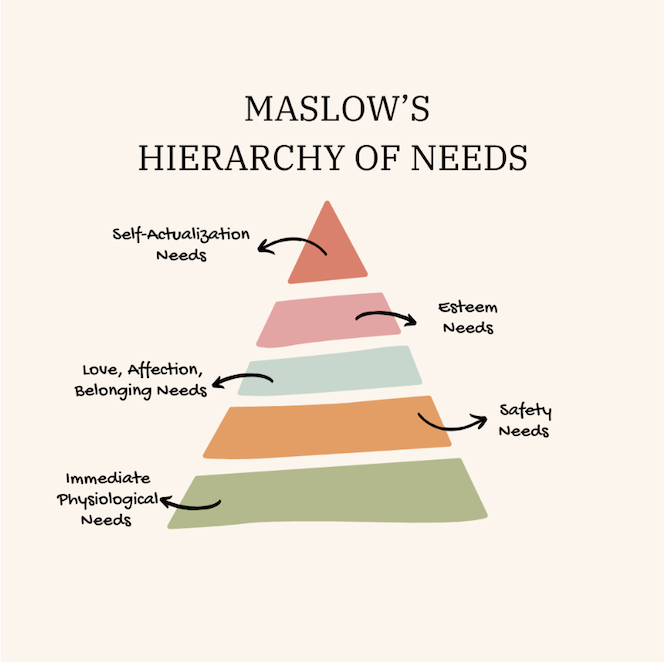
In 1943, A. Maslow postulated a behavioral theory in which he addressed the complexity of human needs by organizing them into a hierarchical structure linking the satisfaction of basic needs to motivation. Although Maslow never depicted his hierarchy as a pyramid of ascending needs, the powerful image first introduced by psychologist Charles McDermid proffers a visual reference and proximate level of analysis that provides insight into the complex relationship between motivation and satisfaction of needs.

Maslow’s Hierarchy of Needs in ascending order from physiological (or biological) needs to growth needs:
- Immediate Physiological Needs—Biological needs for survival: air, water, food, warmth, sleep, clothing, shelter
- Safety Needs—Physical, mental, and emotional security, predictability and control over environment
- Love, Affection, and Belonging Needs—Connectedness, acceptance by others, being a member of a group, feeling confident in relationships with family and peers
- Esteem Needs—Respect, appreciated by others, status, recognition, independence, confidence, includes self-esteem and positive self-image
- Self-Actualization Needs—Need for individual growth, reaching full potential, discovery, personal growth and development, questioning meaning of life and existence, esoteric understanding
Self-actualization can be long-term or short-term and may be characterized by single, transitory moments Maslow termed “peak experiences.” Short-term self-actualization can be as transitory as pride in a single individual accomplishment, e.g., sinking a hole in one.
Maslow divided his hierarchy into two separate and distinct levels: deficiency needs and growth needs. The first four levels of the pyramid are biological needs, i.e., survival needs that are grounded in deprivation and increase in intensity the longer they remain unsatisfied. For example, the need for food increases in intensity as starvation looms. The fifth need is a growth need, i.e., the need to grow as an individual and to reach one’s maximum potential. This growth need may be described as a cerebral need.
As a hierarchy, Maslow ranked needs in order of their perceived importance. Accordingly, a lower level need would have to be satisfied before it would be possible to progress to a higher level need. For example, the physiological need for food would need to be satisfied before the safety need of a secure place to live could be addressed. Although Maslow’s original ranking of needs was fixed and prescriptive, he later postulated that no inflexible structure should govern the order of needs. He recognized that fluctuation between and among the various categories
of needs did not follow a strict linear or hierarchical progression but were bidirectional in nature and could be experienced simultaneously or in a disparate order. Eventually, Maslow endorsed the flexibility to view all tiers of needs independently.
Focus on Education
Teachers are often torn between two conflicting directives: should they concentrate on engaging students through student-centered learning or should they prioritize delivering content mandated by state curriculum standards? As we know, teachers are under tremendous pressure to deliver subject-matter content before standardized testing occurs, but when teachers create learning experiences that place academic achievement before students’ basic needs, students are not receptive to instruction, i.e., students’ capacity to learn is diminished when their basic needs remain unsatisfied. Students who are sleepy or hungry or worried that a
bully will smack them around at recess, will not respond to even the best laid and brilliantly executed lesson plan. Resolving the tension between meeting student needs and delivering essential content information lies in successfully addressing, at the outset, fundamental student needs so that necessary learning can take place. To this end, Maslow provides teachers with the framework to ameliorate varying levels of needs deprivation across all levels of stratification.
Below is a review of Maslow’s Hierarchy as it is applicable to the school environment. It applies to all grade levels (preK-12) and highlights instructional approaches that align with the hierarchy to address 5 categories of student needs.
- Physiological Needs: Provide a supportive environment, maintain a comfortable
temperature in classroom, form a bond with each individual student, listen, observe aberrant behavior, ensure adequate restroom breaks, maintain adequate classroom ventilation, ensure nutritious school meals (lunch and breakfast), make time for movement and physical activity, play games, encourage creative play, flexible seating, work with school psychologist, school counselor, and other supportive staff to ensure that each student has adequate seasonal clothing and safe passage to and from school, maintain communication with the student’s significant others
- Safety Needs: Make school a safe place, maintain order in the classroom, outline clear expectations, prevent bullying, build trust, be consistent, set fair and equitable rules, embolden students to make mistakes safely without criticism, maintain classroom routine, stick to a set schedule, announce classroom interruptions ahead of time, e.g., fire drills, observe facial expression, vocal tone, energy level, eye contact and/or other indications of fear or distress in order to determine student’s affective state
- Love, Affection, and Belonging Needs: Facilitate classroom community building, prompt student collaboration, encourage teamwork, assign group projects, call each student by name, encourage diversity, practice listening, allow students to participate in rule-making, use the ‘buddy’ system, support students with appropriate touching, e.g. a high-five or apat on the shoulder, maintain contact with student’s significant others
- Esteem Needs: Recognize student strengths, praise progress, display student work, assign leadership roles, empower students to lead, praise effort not just achievement, allow students to make a contribution to the group, encourage athletic or team participation, motivate students to develop personal hobbies, embolden students to feel confident in their individual abilities, assign student assistants and helpers, foster student decision-making, welcome constructive criticism, inspire students to keep journals, incentivize students to do their best work, give students opportunity to be proud of themselves
- Self-Actualization Needs: Encourage students to pursue their own interests, encourage realistic goal-setting, provide enrichment opportunities, encourage students to challenge themselves and to be creative, inspire students to accept shortcomings and imperfections without criticism of self or others, allow students to pursue passion projects, encourage realistic perception of reality, unleash individual potential, encourage life-long learning, indulge in inquiry-based learning, acquaint students with concept of intrinsic rewards, utilize asynchronous learning techniques to encourage students to learn/investigate at
their own pace, encourage self-reflection and self-assessment
Self-actualization for students may be long-term or short-term. Short-term self-actualization is characterized by single, transitory moments that Maslow termed “peak experiences”. For students, short-term self-actualization may be in athletics (hittng a home run), in academics (winning the spelling bee), or in extra curricular activities (landing the lead in the school play). Astute teachers strive to provide all students with transitory short-term self-actualization moments in a variety of activities depending on the individual student’s talents, capabilities, and inclinations. Having the best terrarium, doing a good deed for someone else, or even being the best white-board washer can all provide opportunities for students to go beyond self-esteem into the realm of transitory short-term self-actualization.
It is important to reiterate that, over a decade after he first postulated his original hierarchy, Maslow himself recognized that the order of needs is not actually hierarchical, i.e, it is not a fixed or inflexible progression from one need to another. For example, a student who protects an abusive parent is placing the need for love, affection, and belonging before the need for safety.
Maslow before Bloom
Most teachers will have heard the familiar axiom, ‘Maslow before Bloom.’ This axiom refers to the practice of incorporating Maslow’s underlying framework with Bloom’s pedagogical basis for planning and delivering instruction and recognizes that Maslow’s Hierarchy of Needs should be addressed before Bloom’s Taxonomy is initiated. Teachers have found that the skills and abilities embraced by Bloom interface with Maslow’s Hierarchy and that the two go hand-in-glove with the cognitive processes by which learners encounter and assimilate instructional
materials. The six major categories of Bloom’s Taxonomy (also traditionally depicted as a pyramid) include Knowledge, Comprehension, Application, Analysis, Synthesis, and Evaluation. When incorporated with Maslow, they provide a framework for categorizing educational goals, for refining assessment techniques, and for ensuring that instruction and assessment are aligned with the needs of individual students.
Cognitive, Aesthetic, and Transcendence Needs
In the 1960’s, Maslow recognized three additional basic needs that now sit at the pinnacle of the pyramid: cognitive, aesthetic, and transcendence needs.
Cognitive Needs—Knowledge, understanding, meaning, the need to learn and to know
Aesthetic Needs—Appreciation for beauty, balance, form—art, music, nature, literature, poetry, dance, all modes of creative expression
Transcendence Needs—Connecting with higher reality, altruism, unity with the vast expanse of existence, mystical experience, empathy, search for meaning in life, view frailties and strengths with equanimity, spirituality, religion, feeling at-one with the Cosmos, unity with a larger whole, dedication to causes, environmental stewardship, sense of purpose, exploration of consciousness, transcendent ego
Kappa Delta Pi (KDP), the International Honor Society in Education, has recognized these needs as basic for educational professionals and has encouraged schools and school systems to provide in-service opportunities in this area in order to enhance personal growth and development. KDP encourages teachers and other educators to participate in all available activities and exercises that fulfill individual cognitive, aesthetic, and transcendence needs in order to become “self-actualized actors on the educational stage.”
Criticism
The original criticism of Maslow’s work was launched almost as soon as his Theory of Human Motivation was published in 1943 in Psychological Review. This criticism revolved around the observation by Maslow’s peers that the hierarchy was rigid and inflexible and could not, therefore, account for the complex, anthropological—and nonlinear—nature of human needs. Maslow, himself, later addressed this criticism and acceded that human needs are not always hierarchical and must, indeed, be approached bidirectionally.
Another major criticism of Maslow’s work lies in the subjective and qualitative nature of his methodology. From the beginning, psychologists denounced the wholly unscientific approach in which he relied on personal observation and biographical analysis to arrive at concrete conclusions. This lack of empirical grounding to provide a scientific foundation for his hypothesis has led many in the field of behavioral psychology to discredit his theory for dearth of quantitative data and lack of objectivity.
Conclusion
Although Maslow was not the first psychologist to investigate the relationship between motivation and basic human needs, he was the first to categorize needs and to introduce the concept of a hierarchical framework. Although the inflexibility of the hierarchy was later revised, Maslow’s seminal concept remains paramount in our efforts to understand the complex relationship between motivation and basic needs. Drawing from the Aristotelian views of nicomachean and eudemian ethics, Maslow’s concepts of self-actualization and transcendence have profoundly influenced subsequent developments in such divergent fields as eudaemonics
and humanistic psychotherapies including Gestalt and the various branches of transactional analysis.
In the field of education, Maslow’s endures as a culturally sensitive and student-centered tool for addressing the complex system of needs/motivation as it is applicable in the educational setting. As a humanist, Maslow represented a departure from the prevalent mid-20th century behaviorist views of Skinner et al. that motivation is shaped by operant conditioning and driven by a structure of reinforcement that relies on reward and punishment. Standing in diametric juxtaposition to the behaviorists’ contention that internal needs and motivations may be discarded in the process of behavioral analysis, Maslow’s humanistic theory of a needs-based approach to motivation marked a shift in thinking that allowed educators to become more aware of and responsive to the evolving needs of students in our rapidly changing post-pandemic world.
Further Reading:
Copley, L. Hierarchy of Needs: A 2024 Take on Maslow’s Findings. positivepsychology.com/hierarchy-of-needs, 2024
Applying Maslow’s Hierarchy to the Classroom Experience.
ProActive Approaches. Proactive approaches.co.uk/applying-maslows-hierarchy-to-the-classroom-experience, 2023
Maslow’s Hierarchy of Needs. Teachers Toolbox. teacherstoolbox. co.uk/maslows-hierarchy-of-needs, 2022
Kenrick, Douglas et al. RenovaEng the Pyramid of Needs: Contemporary Extensions.
pmc.ncbi.nim.nih.gov/pmc3161123, 2023
The National Assessment of Educational Progress (NAEP). The Nations Report Card.
nationsreportcard.gov, 2024
Maslow, A. A Theory of Human Motivation. Psychological Review, vol.50 (1943), pp. 370-396. psychoclassics.yorku.ca/maslow/motivation.htm
Fredrickson, B. The Eudaimonics of Positive Emotions. American Psychological Association. psynet.apa.org/2016-54448-012, 2016
How Maslow’s Hierarchy of Needs Can Be Applied in Teaching. classcardapp.com/blog/how-maslows-hierarchy-of-needs-can-be-applied-in-teaching, 2024
Maslow’s Hierarchy of Needs in Schools. csaedu.com/maslows-hierarchy-of-needs-in-schools, 2022
Maslow’s Hierarchy of Needs and Its Application in Education. teacherph.com/maslows-hierarchy-of-needs-education, 2021
Desautels, Lori. Addressing Our Needs: Maslow Comes to Life for Educators and Students. edutopia.org/blog/addressing-our-needs-maslow-hierarchy-lori-desautels, 2023
Maslow’s Hierarchy of Needs in Education. educationlibrary.org/maslows-hierarchy-of-needs-in-education, 2020
Kappa Delta Pi. Solving the COVID-19 Conundrum: Using Maslow’s Hierarchy to Meet Students’ Needs. kdp.org/blogs/community-manager/2022/01/13/solving-the-covid-19-conundrum-using-maslows-hierarchy-to-meet-students-needs, 2022
Maslow Before You Bloom in COVID and Post-COVID Era. TRENDSS Consortium. trendss.eu/maslow-before-you-bloom-in-covid-and-post-covid-era, 2023
Association for Supervision and Curriculum Development (ASCD). Maslow’s Hierarchy of Needs and the COVID-19 Crisis. ascd.org/blogs/maslows-hierarchy-of-needs-and-the-covid-19-crisis, 2023
The Nicomachean Ethics of Aristotle. Project Gutenberg. gutenberg.org/files/8438/8438-h/8438-h.htm, 2003
McLeod, S. Operant Conditioning: What It Is, How It Works, and Examples. Simply Psychology. simplypsychology.org/operant-conditioning.html, 2024
Leave a Reply