

By Tracy Christenson and Holly Christopher
Medicaid and “Free Care”
About 10 years ago, significant changes to Medicaid guidance made school nursing services billable. Before that, services provided to members of the community without charge (“free care”) were not billable to Medicaid, but this policy created an ambiguity when services were provided to individuals covered by Medicaid and were provided by healthcare professionals who were Medicaid-qualified because it meant that services that would otherwise be paid for through Medicaid were not eligible to be billed to Medicaid. If those services were eligible to be covered by Medicaid for certain individuals but were not billable to Medicaid or to the recipients of the services, the money to cover those services had to come from another source.

When the policy of not allowing Medicaid to be billed for “free care” (as in free to the recipients) that would otherwise be covered by Medicaid was challenged in 2004, the Departmental Appeals Board decided that the policy wasn’t an accurate reflection of the Medicaid statute or regulations, which is why the Centers for Medicare & Medicaid Services (CMS) decided to issue new guidance on this policy. The new guidance for billing focuses on the issue of whether or not services are covered by Medicaid, not whether or not the recipients of the services are charged for them. The change in Medicaid billing guidance was in the interests of promoting public health and access to healthcare services.
Although the new guidance has been in practice for years, some people still find themselves questioning what it means and what the conditions are. To clarify the issue, Federal Financial Participation (FFP) for Medicaid payments applies when the following conditions are met:
- The recipient of services is covered under Medicaid.
- The services provided are covered under Medicaid, in keeping with state plan methodologies.
- The provider participates in Medicaid and meets federal/state qualifications.
- The state plan includes a payment methodology specifying appropriate rates.
- Third party liability (TPL) requirements are fulfilled. The Medicaid statute requires states to pursue claims for payment from legally liable third parties. Schools, public health agencies, and child protective services are not typically considered legally liable third parties for the purposes of federal Medicaid reimbursement, although this can vary because of differences in state laws.
- There is no duplication of payments for the same service from a source other than Medicaid.
- There is auditable documentation from the provider and state that supports FFP claims.
- The state provides financial oversight for billing practices.
- All the statutory, regulatory, and policy program requirements are fulfilled.
As long as these conditions are met, Medicaid can reimburse payment for services covered under Medicaid, whether or not the recipients of those services or other general members of the public are charged for them.
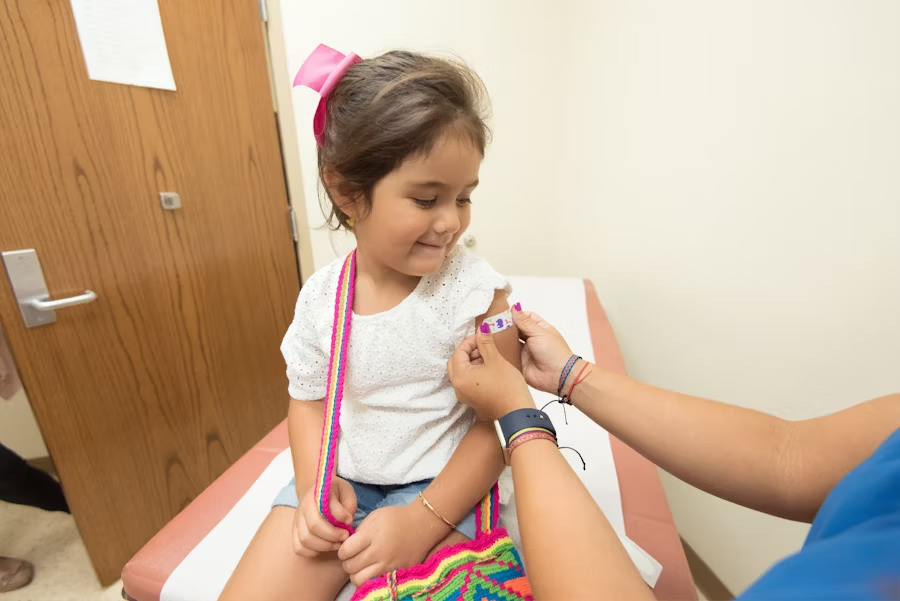
School Nursing Services
When schools are not regarded as legally liable third parties for the purposes of federal Medicaid reimbursement, school nursing services are billable to Medicaid. Tennessee schools can receive reimbursements from TennCare/Medicaid for eligible services provided by school nurses to students who are covered by Medicaid, including:
- Diabetes care
- Tube feedings
- Asthma management
- Medication administration
- Catheter & Trach tube care
- Management of all chronic conditions
- School nursing provided to General Education & Special Education students
The changes to the billing guidelines made it easier for Tennessee schools to receive reimbursements from TennCare/Medicaid. If your school district needs help claiming the extra funding for healthcare services from TennCare/Medicaid, Stellar Therapy can help you!

We Take Care of Everything!
Stellar Therapy’s “We Take Care of Everything” Program includes:
- Obtaining therapists’ health licenses, credentialing therapists with the insurance companies, and training therapists on compliant documentation techniques.
- On-going training and support for school administrators in all aspects of program management.
- Communicating with state agencies and insurance companies on behalf of the school district.
- Submission of billing claims on behalf of the district, monthly reporting of reimbursements received, and assistance with federal requirements.
- Online registration forms for parents.
- Extensive clinical training opportunities and materials for therapists and school employees.
- A user-friendly web-based documentation system (unlimited users).
Contact us about Stellar’s “We Take Care of Everything” program to find out how to get started receiving additional funds to support your school nursing department!
Sources
Re: Medicaid Payment for Services Provided without Charge (Free Care). Letter. Department Of Health & Human Services, Centers for Medicare & Medicaid Services. December 15, 2014.
School-Based Services Guidelines: Providing and Billing Covered Medicaid Services Provided by the School Nurse. Updated July 1, 2023.
Leave a Reply